I'm writing this post in memory of Madeleine Albright, former UN Ambassador (1993 to 1997) and first woman Secretary of State (1997 to 2001). My deepest sympathies go out to the family and to the world for the loss of an inspirational leader and role model.
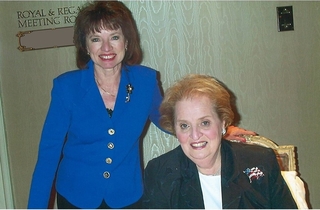
I had the honor of meeting Madeleine Albright several years ago at a Women’s History Month event in Chicago following her reign as Secretary of State during the Clinton administration. She was the first woman to serve the position of Secretary of State in the U.S.
At 4 foot 10 inches (147 cm), Ms. Albright made my 5 foot 2 inches (157 cm) height feel TALL. However her stance to the world always felt well over 6-foot tall, and she serves as a lesson to all of us to let nothing stop us from feeling and being powerful! Just use the right attitude, words, and approach to find a diplomatic resolution to every situation. This was part of what she brought to the world.
For instance when I shared my business card with her at the beginning of our “walk and talk” conversation after lunch, she looked at it for a moment and then asked if I covered the vital role of diplomacy in my corporate training. I responded, of course but it started me thinking. Ultimately her comment readjusted my mindset and made me go deeper, for a more complete solution.
Ms. Albright emphasized that diplomacy is not just for diplomats; it should be the rule in the workplace and in every facet of our life. I have since done just that and added all the various components of diplomacy to my training curriculum. So grateful to have had this memorable opportunity. I wish I could have had more time with her … so many questions … but realized that I had just enough conversation to create a turning point in my training.
Inspired, I revisited my coursework and identified powerful words that generate win-win communication. They include diplomacy, finesse, tact, dignity, and civility. We hear these words, but do we know what they mean and how to use them effectively? Although there is some overlap, they serve the same purpose. Engage them as preventive measures for diffusing situations that could easily get out of control. This is especially true during times of domestic uncertainly and international unrest.
Diplomacy is the skill of managing people, and the ability to communicate in a non-offensive manner. It is also the conduct by government officials to secure safe relations between nations. Instead of encouraging conflict, diplomacy focuses on resolving conflict. It is not necessarily what you say, but how and when you choose to say it. When managing sensitive conversation topics or mistakes, a diplomatic approach allows you to remedy the situation without damaging the relationship. It consists of one’s mannerisms, demeanor, attitude, and timing. In other words, the way you present your views determines the outcome.
Dignity is an individual’s self-respect. It is something that should be given and not taken. People need to have a sense of dignity about themselves regardless of what economic background they come from, or awkward situation that just occurred. Maintain dignity (keep your head high) when things go wrong.
Finesse is the skillful way you manage a difficult or highly-sensitive situation that might be difficult for others. It also demonstrates the cleverness someone shows in the way they resolve a problem or situation.
Tact is the act of using gentle (non-offensive) language when dealing with controversial issues. Tact is knowing what to say to avoid giving offense, and how and when to say it. Tact involves choosing words that are not emotionally charged or confrontational, while demonstrating respect for the other person’s rank, position, stature, gender, age, nationality, ethnicity, whatever the case may be. Sometimes tact will mean not saying anything at all.
Civility is courtesy. Civility can maintain balance in a disconnected environment. Civility creates a common bond and a more harmonious environment. For example, when you do not like someone, yet manage to treat him politely, you are being civil.
These terms are all-encompassing. It is how an incident is managed, not the incident itself, that is the key to a successful result.
A Fun Note: Did you know that Madeleine Albright wore decorative pins and brooches that sent messages? The brooch in the photo is a flag to demonstrate her patriotism and love of country. There were times when she wore a pin to specifically send a message which, became known as her “pin diplomacy” (source: USA News Today, March 23, 2022).
I noticed that she always worn them on her left, which is the same placement for military medals.
The world lost a great leader this week, whose legacy will live on.
Gloria Petersen - Founder/CEO at Global Protocol Academy
“Too many people associate diplomacy with government. Diplomacy is a part of every facet of life!” — Madeleine Albright
Read more... Hillary Clinton: Madeleine Albright Warned Us, and She Was Right
Read more... Madeleine Albright Had a Lot to Say About Putin, and She Didn't Mince Words
Read more... Putin's Moves on Ukraine Will Be an Historic Mistake
Read more... Memories of Madeleine Albright by Barbra Streisand
Global Protocol Academy is a member of Global Chamber®.
Global Chamber® is a growing and collaborating community of CEOs, executives and leaders in 525 metro regions around the world... connecting member businesses to new opportunities and advancing growth and success. It's the only chamber of commerce in the world operating in hundreds of locations that helps exporting, importing and investing members to connect through warm introductions to clients, partners, projects and resources. Global Chamber® is a registered trademark of Global Chamber LLC since 2014.
Originally published at https://www.globalchamber.org/blog/2022/03/24/global-chamber/remembering-madame-secretary-madeleine-albright/